

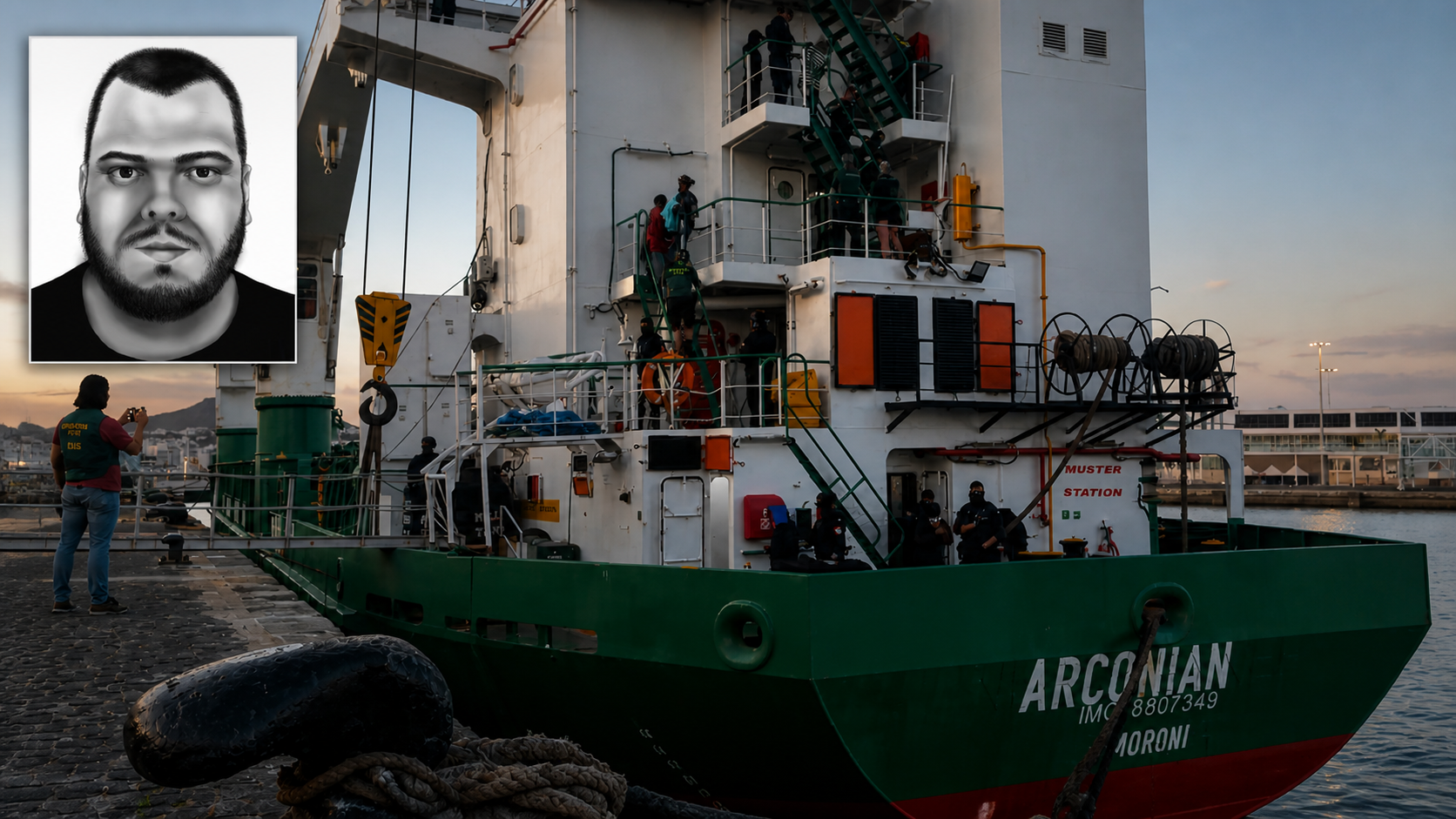

One of the most wanted Dutch criminals, Jos Leijdekkers – better known as 'Bolle Jos' – is linked to one of the largest cocaine seizures ever at sea. In the Atlantic Ocean, the Spanish Guardia Civil intercepted a cargo ship with an estimated 30.000 to 45.000 kilos of cocaine on board. If these figures are correct, it concerns a historic seizure with a value that could reach over 1,5 billion euros.
Ship from Sierra Leone en route to Europe
The ship, the Arconian, departed from Freetown in Sierra Leone on April 22 and officially had Libya as its destination. According to researchers, this route served as a cover. It is suspected that the cargo would be transferred at sea or on the North African coast to smaller boats to enter Europe.
The Guardia Civil monitored the ship for days and eventually intervened in international waters near Dakhla. During the operation, 23 crew members were arrested, including Dutch nationals. Notably, according to Spanish media, there were armed guards on board and firearms were found, which underscores the seriousness and professionalism of the operation.
Link to top Dutch criminal
The seizure is linked by international law enforcement agencies to 'Bolle Jos', who has been regarded as a major player in the international cocaine trade for years. He is wanted internationally and is linked to large-scale smuggling and violent crimes.
According to multiple sources, he is currently hiding in Sierra Leone, where he may be enjoying protection within influential circles. His exact role in this specific case is still being investigated, but the link alone makes this arrest particularly significant.
Corruption and international networks
With a shipment of this magnitude, more than just logistics is almost always at play. A ship carrying tens of tons of cocaine does not simply move through international waters without systems being bypassed somewhere. This often points to corruption and collusion within multiple links of the chain.
From ports of departure to routes and checkpoints, there are moments when these types of transports can be stopped. The fact that they still manage to get this far shows how organized and deeply rooted these networks are.
West Africa as a crucial route
Sierra Leone's involvement fits within a broader trend in which West Africa is used as a transit point for cocaine from South America bound for Europe. From there, shipments are further distributed by sea or smaller transports.
Spain subsequently serves as an important gateway to Europe, partly due to its strategic location between Africa and the European mainland.
Historic catch of greater significance
The Spanish Minister of the Interior spoke of a “historic blow” against the international drug trade. The size of the shipment surpasses previous records and shows how large and professional current smuggling routes have become.
At the same time, this case makes it clear that the drug world continues to scale up. It is no longer about kilos, but about tons. Not about small networks, but about international structures with influence, money, and power.
Source: nos.nl

